

Market Review and Outlook - 2nd Quarter 2025
July 28, 2025
Blog Image


Market Review

Equity markets shot sharply higher throughout the second quarter of 2025, with the S&P 500® Index up 10.94% for the quarter after President Trump delayed the implementation of reciprocal tariffs. Large- and mid-growth stocks led the domestic equity group, while real estate and small-value stocks lagged the broader market. The weakening U.S. dollar was a tailwind for foreign stocks, which also returned double-digit gains. With the threat of tariffs temporarily sidelined, foreign small cap stocks performed particularly well.


Within fixed income, long-duration bonds underperformed their shorter-duration counterparts, as the yield for the 10-year Treasury trended higher over the quarter. Optimism also spread throughout the credit space with bank loans, emerging market debt, and high yield bonds delivering positive gains for the quarter.


Outlook

Valuations and fundamentals seem to have had minimal influence over the market throughout the first half of 2025. Geopolitics typically have transitory market impacts; however, the recent situation calls for closer examination due to the spontaneity of Trump’s policy efforts. For instance, the announcement of reciprocal tariffs surprised the market, and the S&P 500 Index tumbled roughly 12% in just a week. Nonetheless, this drop proved temporary after the Trump administration rescinded his reciprocal tariffs, postponing the implementation for 90 days. Since then, the market quickly recovered those initial losses, ending the second quarter with double-digit gains.


Further adding to the positive momentum, the One Big Beautiful Bill Act of 2025 squeezed through the U.S. Congress, and it is expected to provide some stimulus for the economy—although many of the tax cuts involve extending some key provisions that were set to expire soon. As long as the labor market remains stable, consumption should continue to support the U.S. economy with the additional tax-relief boost. Inflation has calmed down and continues to gradually ease toward normalcy, further contributing to healthy consumption.


Although the economic outlook has some positive aspects, risk continues to loom over the global economy and markets. The markets may have bounced back from the first round of the trade war, but that recovery could be based on the idea that the administration will always retract economic threats at the last minute. The risk of a highly damaging trade war remains a serious threat, which merits some caution throughout the remaining half of 2025. Reciprocal tariffs could eventually fade, but Trump and his administration can introduce other trade barriers as they deem necessary. Since the S&P 500 Index has recovered and reached new highs, the administration may opt for more stringent policies to achieve their goal of winning favorable trade terms.


Amidst the trade-war confusion, inflation remains a key theme impacting many areas. Some argue that tariffs are inflationary, while others maintain that they are only one time price increases. Both sides make valid points, and the actual impact would likely depend on the longevity of a trade war as well as how each trading partner handles the conflict. Prolonged tit-for-tat responses would likely have inflationary effects. These are considerations the Fed is likely weighing as the central bank plans and executes its monetary policies. Before the start of 2025, many had anticipated several interest-rate cuts from the Fed. However, Fed Chairman Powell and other voting members have yet to cut rates since their last cut in December 2024.


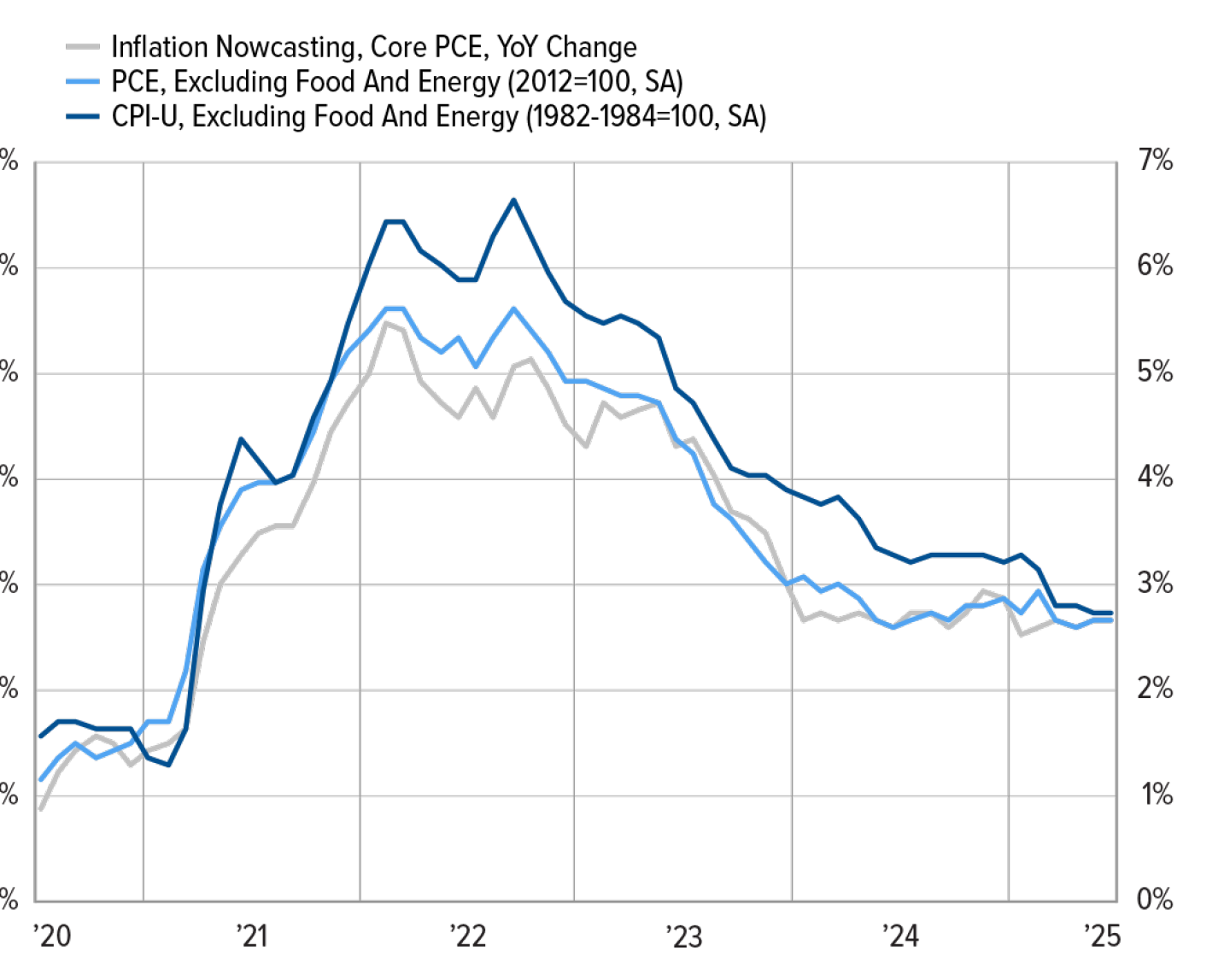
Inflation has come down, although the pace has leveled off.
 

Source: FactSet


Core inflation has settled throughout 2025 but continues to run at a pace above the Fed’s target level of 2%. Under these circumstances (assuming a healthy economy and consumer base), the Fed has very little to no reason to cut rates, despite the demands of the Trump administration. Tariffs would increase prices instead of reducing them. However, if the labor market begins to deteriorate materially, the Fed will be forced to cut rates.


Much will depend on the execution of the president’s stimulative policies following the roundabout trade-policy confusion throughout the first half of the year. Over the next half of the year, the administration could boost economic activity with tax cuts and deregulation. Nonetheless, geopolitical issues could continue to derail markets, which would have economic consequences.


We continue to remain cautiously optimistic and will be prepared to weather any potential storms or ride the wave in favorable conditions. We will continue to monitor these quickly changing environments and adjust our allocations accordingly and in a timely manner.


For more insights from Pacific Life, visit PacificLife.com


This material is educational and intended for an audience with financial services knowledge.


Pacific Life Fund Advisors LLC (PLFA), a wholly owned subsidiary of Pacific Life Insurance Company, is the investment adviser to the Pacific Select Fund (PSF) which is available through certain Pacific Life variable annuities. PLFA directly manages certain PSF funds-of-funds.

This commentary represents the views of the portfolio managers as of 7/11/25 and are presented for informational purposes only. These views should not be construed as investment advice, an endorsement of any security, mutual fund, sector, or index,
or to predict performance of any investment. Any forward-looking statements are not guaranteed. All material is compiled from sources believed to be reliable, but accuracy cannot be guaranteed. The opinions expressed herein are subject to change without notice as market and other conditions warrant. Sector names in this commentary are provided by the Fund’s portfolio managers and could be different if provided by a third party.

This material is provided for informational purposes only and should not be construed as investment, tax, or legal advice. Information is based on current laws, which are subject to change at any time. Clients should consult with their accounting or tax professionals for guidance regarding their specific financial situations.

Pacific Life refers to Pacific Life Insurance Company and its subsidiary Pacific Life & Annuity Company. Insurance products can be issued in all states, except New York, by Pacific Life Insurance Company and in all states by Pacific Life & Annuity Company. Product/material availability and features may vary by state. Each insurance company is solely responsible for the financial obligations accruing under the products it issues.

The home office for Pacific Life & Annuity Company is located in Phoenix, Arizona. The home office for Pacific Life Insurance
Company is located in Omaha, Nebraska.


VLQ1822-00

7/25

Pacific Life, its affiliates, distributors, and respective representatives do not provide tax, accounting or legal advice. Any taxpayer should seek advice based on the taxpayer’s particular circumstances from an independent tax advisor or attorney

Pacific Life is a product provider. It is not a fiduciary and therefore does not give advice or make recommendations regarding insurance or investment products.

Unless otherwise noted, all aforementioned money managers, their distributors, and affiliates are unaffiliated with Pacific Life and Pacific Select Distributors, LLC.

Pacific Life refers to Pacific Life Insurance Company and its subsidiary Pacific Life & Annuity Company. Insurance products can be issued in all states, except New York, by Pacific Life Insurance Company and in all states by Pacific Life & Annuity Company. Product/material availability and features may vary by state. Each insurance company is solely responsible for the financial obligations accruing under the products it issues. 

Variable insurance products are distributed by Pacific Select Distributors, LLC (member FINRA & SIPC), a subsidiary of Pacific Life Insurance Company and an affiliate of Pacific Life & Annuity Company. 

The home office for Pacific Life & Annuity Company is located in Phoenix, Arizona. The home office for Pacific Life Insurance Company is located in Omaha, Nebraska.

No bank guarantee • Not a deposit • Not FDIC/NCUA insured • May lose value • Not insured by any federal government agency

For financial professional use only. Not for use with the public.